Tuesday, November 8, 2016

Travel to the Arctic

The number of tours/cruises available to the Arctic and Antarctic are rapidly increasing. It seems that this is the new travel frontier.
Of course, cruises through the Northwest Passage to Alaska and also along the coast of Norway, have been happening for a long time now.
But now travellers now want to see Iceland, Greenland and the northern lights.
And to see the northern lights you need to travel in the northern hemisphere winter.
We travelled to Churchill to see the polar bears, and then continued on to Alaska and up the famous Dalton Highway to the Arctic Circle to see the Aurora Borealis.
The polar bears migrate to the Churchill, Canada, area for only about 6 weeks a year as they wait for Hudson Bay to freeze over so they can go out to hunt seals.
Before that we spent a few days in each of New York, Montreal and Quebec.
That made for a very tricky situation for a cabin bag only trip!
The cities we visited late October and the polar bears early November - so we needed to be prepared for temperatures down to -30C.

The clothes list included: heavyweight woollen thermals, woollen skivvy, polar fleece sweater, thick polar fleece jacket with hood, down-filled vest and ski jacket. That's six layers on the top! The bottom layers included heavy weight woollen thermal leggings, thick polar fleece pants, waterproof overpants, long thick woollen sox and snow boots. All this plus mittens, woolen face/neck warmer, beanie and scarf.
Looking for a warm sweater in a shop, I was attended by a chap from Minnesota. He approved of my layers and said I would be fine. He said I would survive in Minnesota and if you can survive there the Arctic Circle is a breeze!

But for the cities we wanted a more urban look of course. I wore winter weight R M Williams cream coloured slacks plus leopard print boots. Added was a top for evening and pretty scarf.
We felt very pleased with ourselves when we were mistaken for locals on Montreal! So it goes to show you don't always have to look like a tourist!
Our bags were slightly over the 7kg limit (my boots weighed 1kg each!). We could have worn them through check-in but decided against it but had no issues. Of course we wore several of our layers but re-packed when we were in the lounge.
So don't be deterred when going to a cold country. It is quite manageable with a cabin bag. There might not be much variety in clothes but when you are in the Arctic no-one really cares!

Travel light!
Marie

Tuesday, December 4, 2012

Dallas/Fort Worth Remembered

Read an article the other day about the increasing size of Dallas/Fort Worth Airport in the US. It handles 58 million passengers a year, and it appears that it might overtake LAX in passenger numbers as it contimues to expand, with a new terminal being planned.

We travelled to Dallas a few years ago and remember the airport well. The train connection to Dallas which we had read about in our travel guide didn't actually exist. And if you haven't already arranged for a hotel shuttle to pick you up, the only option is to get a taxi. A lesson in checking these things out thoroughly.

The city of Dallas has few attractions - its main claim to fame being where JFK was assassinated in 1963 - something remembered by us baby boomers.

School Book Depository building on Dealey Plaza, Dallas, Texas
The School Book Depository building where Lee Harvey Oswald fired the fatal shots (if you don't believe in conspiracy theories!) now houses the Sixth Floor Museum. It covers events leading up to the assassination and second by second photos of JFK's last moments - a bit unsettling when you know the outcome.

The museum also addresses the official enquiry as well as the various conspiracy theories.

Outside at Dealey Plaza, crosses are painted on the road where the two shots hit Kennedy - a slightly gruesome touch. And of course there is the infamous "grassy knoll"!

We couldn't find the Conspiracy Museum - maybe closed? But did spend some time at the Kennedy Memorial - a simple monument but quite moving in a way.

Fort Worth is well worth a visit, even if you only go to the Stockyards National Historic District. The city was the major centre of livestock trading in the days of the "west" and this area is now home to small museums and shops selling anything to do with cowboys and the west. It is the place to buy a pair of cowboy boots!
Longhorn drive at the Stockyards, Fort Worth, Texas

Every day they drive a herd of longhorns down the main street, accompanied by settlers in their wagons and wearing period clothes. It is a lot of fun and those horns are sooo..... wide!

Later we  discovered there is a train to Dallas/FortWorth but it stops outside the airport boundary. After arriving passengers then have to wait for a shuttle bus to take them to the airport, where they then need to catch the bus that goes to their terminal - a lengthy process.

Loved the area though - well worth a visit - and, yes, everything does seem to be bigger in Texas!

Getting back to passengers - do you know the busiest airport in the world by passenger numbers?

Bet you didn't say Atlanta, with 92 million!! Some-one please let me know why!!


Light travelling!

Marie

Thursday, September 20, 2012

To Scarf or Not To Scarf

In Imam Square, Esfahan, Iran
Soon I will be travelling to Egypt and the issue of appropriate dress arises - should I wear a scarf or not?
I am a great believer in observing the culture and customs of the countries I visit. However the issue of covering up in Islamic countries is a contentious one for western women.

A fellow traveller once told me she would never travel to a country where she was required to wear a scarf. This is a rather illogical view as she would have no doubt been happy to cover her shoulders to enter St Peters Basilica at The Vatican for instance. Or to not wear short shorts.

During a visit to a Russian Orthodox cathedral in Irkutsk, we were asked to cover our heads - some women were not happy about this but if they attended church at home, I'm sure they would have been modestly dressed.

Heck! Even at Royal Ascot's Royal Enclosure, womens' dresses must have shoulder straps no less than an inch (2.5cm) wide, must be no shorter than just above the knee etc...And I'm sure the ladies are very happy to comply!!

A few years ago I travelled through Iran where there is a very rigid dress code for women. Long pants and long sleeved tops must be loose, darker colours and a scarf must always be worn.
Strangely, I found this very liberating! What I was wearing, as long as it fitted the standard, seemed to be of no significance. And covered up my less than perfect body - a win win situation! The only problem was the heat - a scarf can be stifling in hot climates!

Combo! Scarf plus hat - hot but necessary!
Quite a few years ago I visited Morocco. The king is a bit more "westernised" than other muslim rulers. I didn't wear a jellaba or scarf. I noticed men stared at me a lot - probably because my very short hair was a bit of a novelty. Looking back, a scarf would have been a good idea.

And I'm not into the old argument about men shouldn't look etc etc - if you are in another country, observe their customs.

So, to scarf or not to scarf?

I will wear a scarf in Egypt because women in Egypt cover their heads. And with the change to an Islamic government there seems to have been a slight tightening of the dress code - a female television newsreader now wears a scarf whereas she did not before. Plus the recent protests against the west make not standing out a sensible idea.

So my trusty scarf will be in my bag again - hardly takes up any room or weight - and might just make the difference between an enjoyable holiday and one marred by anti-west sentiment.

Light travelling!

Marie


Tuesday, August 28, 2012

Open Your Mind and Really Experience the World!

Breakfast in nomad tent in Iran - shared by 11 men and women!
Recently I was talking with friends about travelling - what else!? - it seems to be the most popular topic amongst baby boomers!

One friend insisted that she would only stay in 4 or 5 star hotels when travelling.

I thought about that and wondered what sort of travelling experience she wanted, and why did she travel anyway if her view of the world was only going to be from a generic luxury hotel. And a lot of the world doesn't have luxury hotels! What experiences she would miss out on!
 
I remembered the places where I have slept over the years - on a mat on stony ground in a nomad tent in Iran, in a nomad ger on the Mongolian steppe, in a hut made from reeds in Botswana....

I remember a cheap 2 to 3 star hotel in St Petersburg - we preferred to climb up 3 flights of stairs to our room because the lift was dodgy, but it was a minute walk to The Hermitage - how good is that? Worth more than a fancy hotel room further away!


Our reed hut in Botswana - the bathroom is behind the screen!
Plus I have slept in any number of train cabins across Russia, America, Canada, and South Africa.

Although there might not have been much sleep due to discomfort, these are the experiences we remember and laugh about.

Don't get me wrong - I don't mind a bit of luxury. After leaving Iran we booked into the Hyatt in Dubai just to enjoy first class facilities, and a decent shower! And an alcoholic drink after not being allowed to drink in Iran! And we have stayed in some wonderful lodges whilst "on safari" - very welcome after a dusty day game viewing.

But to limit yourself to visiting places with only luxury hotels seems to be a very narrow view.  Plus there are a lot of laughs missed and funny stories to be told!

Light travelling!

Marie


Nomad ger in Mongolia - note satellite dish and solar panel!
Buying platform food on the Trans Siberian


Saturday, May 19, 2012

Deserts and Gardens

Melbourne has two great exhibitions on at the moment - "Mesopotamia" at Melbourne Museum and "Love and Devotion: Persia and beyond" at the State Library of Victoria.

Mesopotamia, the area around the Tigris and Euphrates Rivers, is known as the "cradle of civilisation". Here developed a type of writing (and record keeping) known as "cuneiform" - shapes pressed into a wet clay block with a reed. Astrology began here with stargazers naming the constellations that we know today as the Zodiac. And that most basic of units we use each day - the 60 second minute and 60 minute hour - come from Babylonians using 60 as their unit of measure (like we use 10 today).

Why did this culture not develop as in Europe? Possibly because of the harsh climate, there was no possibility of growing any crop in quantities large enough to trade - the available water used to merely exist. Herds of sheep and goats which provided daily needs, surviving on the desert grasses.

Iranian desert

One of the Seven Wonders of the Ancient World was The Hanging Gardens of Babylon. No doubt famous for the ingenuity required to build them out of the surrounding desert, as well as the welcoming sight. One stone relief in the exhibition shows a garden with water channels running through the flowering shrubs and trees.

Some suggest that the gardens were a myth. For anyone who has visited northern Africa or Middle Eastern countries, it is easy to see how the gardens could have existed. Lack of surface water brings out invention.

In 2009 we visited Iran. Except for a small area in the north, the country is desert. But the major cities have beautiful gardens in abundance. Some are now a little worse for wear thanks to lack of government funding (or interest). Maybe gardens are seen by the government as a reminder of the ostentation in Iran under the Shah pre the 1979 revolution.

The "Love and Devotion" exhibition is of illustrated manuscripts - miniature painting is still an art in Iran today. Most manuscripts show figures (usually lovers) relaxing in lush gardens. Or beautiful gardens are visible through palace windows. The stories or poems are usually along the age-old theme of love and loss. Apparently Shakespeare's Romeo and Juliet is based on an ancient Persian story.
Bagh-e Eram gardens in Shiraz

But the question is, in such a harsh climate, how were gardens possible and how did they survive?


In Iran most water flows in underground rivers. For centuries, engineers have built "qanats" - water tunnels built underground from the rivers to towns. Houses "tapped" into the qanats like using a well.

We visited beautiful gardens in Shiraz and Isfahan. Shiraz is home to several tombs of famous poets such as Sa'di and Hafez. Iranians love their poets and the tombs and surrounding gardens are very popular with families.


Normal dress for young women in Iran

Iran is an easy place to travel light. Women need to cover up completely - no matter the weather! I found it quite liberating not having to worry about what I wore as long as it adhered to the dress code.

Most women on our tour had two outfits only and just alternated them.

The basic rules are loose pants, full length sleeves and headscarf. Look at the young women in the photo - that is how visitors are expected to dress. And look at the gardens! - these are in Isfahan.

One word of warning for women though - in Iran you are second class citizens. Men will ignore you and not speak to you even if you speak to them. (Excepting hotel staff etc)

Of all the places I have visited, Iran is the most fascinating. There is always something new and wonderful to see. The scenery is stunning - yes, even the desert! The people are the friendliest I have come across. And I always felt safe. More than you can say for a lot of western countries.


Light travelling!

Marie


Wednesday, March 21, 2012

The Original Light Traveller

Did you assume that travelling light was a fairly recent phenomenon?

Well, it seems not!

I have just been to the "Grace Kelly: Style Icon" exhibition from the Victoria & Albert Museum,  showing at the Bendigo Art Gallery.

One display showed an issue of the April 1955 Women's Home Companion (an American magazine). It was opened at an interview with Grace Kelly and she gives her tips on travelling light. She wears an ensemble of tweed travel coat over a worsted suit of jacket and straight skirt and blouse with a big bow at the neck.

 Her coat could be worn over anything in her wardrobe, except evening wear. Sounds familiar doesn't it? And still great advice today!

Her aim was to avoid going over the 66lb (30kg) luggage limit!

So many points jump out at me.

Firstly, she was a Hollywood star - why would she worry about paying for a bit of excess luggage? Secondly, the outfit, while very elegant, looks just so uncomfortable. A tight woollen skirt on a flight across the Atlantic? - Hmmm.

And how have luggage regulations changed? - 30kg? Well I guess she would have been travelling First Class.

It all harks back to different times.


One thing that did resonate with me though, was that she always made a list of what to pack. That is the best travel tip ever, whether it is the 1950's or 2012.

So when you are wearing your trackies across the Pacific or wherever, carrying just cabin baggage, think about Grace Kelly, style icon of the twentieth century.

Light travelling!

Marie

Tuesday, January 31, 2012

Children and Air Travel

Summer holidays have finished and children are back to school. This means a lot of children have been flying in the last 6 weeks and the issue of their behaviour whilst flying is in the news again.

Parents need to ensure that children observe a few general courtesy rules such as not kicking the seat in front. However it is not easy to keep young ones entertained on a long haul flight. Books and games can amuse for only so long. It would be nice if planes had a small area where children could quietly play instead of being restricted in a seat - maybe take out the last couple of rows. But I guess seats means dollars.

Last year an airline put a ban on children in First Class. This might be a great solution for passengers but why don't airlines look at the underlying issue - WHY do children become disruptive?

When I first started flying in the 1970's, the cabin did not have the "rules" that exist today. The routine now is, after take-off a meal is served then the cabin lights are turned off and blinds closed. This system is in place whether departure is in the day or night. In the last few years I have made several flights ex Australia departing around midday. Turning off the lights is not an issue for me because I can watch movies or read or sleep. A child is not ready for sleep mid-afternoon but is expected to be silent and stay still. Try explaining to a toddler that all of a sudden they have to sleep. No wonder they are not happy - it's still daytime!

Why do airlines insist on this routine? Why can't cabin lights stay on and blinds stay up until it is "night" for the passengers' bodies and they are ready for sleep? Is it to make less work for the cabin crew? If they make us sleep, they don't have to provide service? Strangely, most airlines provide eye masks but not the conditions to use them!

Last year I flew from London to Hong Kong. The flight departed Heathrow at midday. After lunch, lights were out and blinds down. Despite the best efforts of the parents, the children behind me were unsettled and crying until the lights came on for the last couple of hours - then they did not make a sound and were happy!

Don't blame the children. Blame the intransigent airline policies.


Light travelling!

Marie


 PS I prefer children over drunks talking loudly and constantly going to and from the toilets!

Tuesday, November 29, 2011

New rules for liquids in hand luggage

No doubt you will have seen the item in the newspaper last week about new rules for liquids carried in hand luggage. New scanning equipment can now detect minute traces of explosives in liquids.
My first thought was "great"!! but after reflection I'm not sure if there are many benefits.

The main one is that women will find it easier to carry a decent range of cosmetics and toiletries - no more adding them to a partner's bag!

If you can now carry liquids of more than 100ml I assume these will be scanned by the new equipment. Instead of speeding up check-in as claimed, I would have thought that it would do the opposite. With no more than 10 containers of less than 100ml in my bag, security was a doddle - no hold ups. But now I will need to have my duty free perfume or whisky scanned? Hmmmm...
The new rules will be in force in Australia in 2012 and in 2013 in Europe.

It will be interesting to see how it goes - fewer passengers fuming over their duty free purchases being confiscated maybe, but more scanning of bigger containers, which also takes time.

Also bigger containers means more weight!! Not ideal when travelling with only cabin baggage.
For me, I think I'll stick with the old system of smaller containers.


Light travelling!
Marie

Sunday, October 30, 2011

The Ghan, Darwin and Kakadu


With Elizabeth and Jonathon at Adelaide
The last thing I thought of when we boarded The Ghan in Adelaide was being held up by bushfires! We left Adelaide at midday Wednesday for this iconic trip up through the "red heart" of Australia. On Thursday morning we awoke and found ourselves stopped in the middle of nowhere (actually the far north of South Australia) and with no reasons why from the crew. Eventually we were informed that because of bushfires near the track we needed to await permission to procede. So we continued through burnt-out country, stopping for hours, then moving forward  until the next stop. Apparently, we had to wait until trains ahead of us had completed a "section" before we could then enter it. There was a surprising amount of vegetation in the unburnt areas - not the red centre at all, more like the green! The consequence of all the rain since the breaking of the drought I suppose. In the meantime the staff were helpful and informative and the meals and wine excellent! Arriving at Alice Springs 6 hours late meant that we couldn't do the tours we had booked - we had planned to do a camel trek. Having already been to "The Alice", this was not a problem but for passengers who hadn't seen it, there was disappointment. We made up little time in Alice so, again, couldn't go on the tours arranged for Katherine - this time a canoeing trip up the Katherine Gorge. C'est la vie.
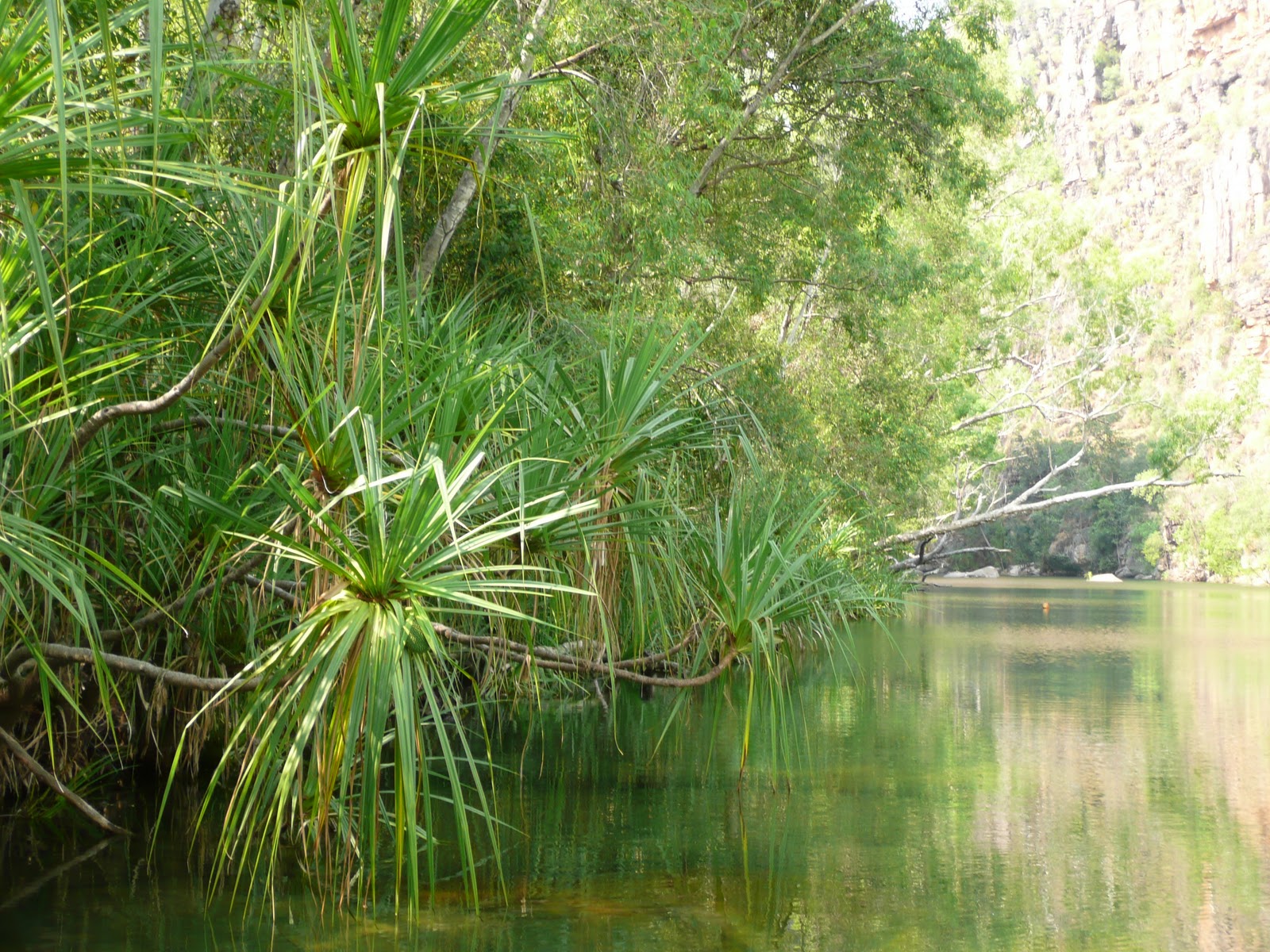
Typical tropical woodland vegetation

Spent the weekend in Darwin with my sister before hiring a 4WD Prado to take us out to Kakadu National Park.October is not the best time for Kakadu - it is beginning to steam up for the wet and the days are very muggy and hot. Of course I was travelling with just my cabin bag and I trialled my tennis tops in the humidity - what better place to test clothes for hot, humid conditions! They did really well, especially the Lululemon Athletica gear - a great fabric which did not get sweaty and felt cool. July is the peak time to visit. We visited most of the main sites - starting with the Mamukala wetlands on our way to our hotel. There is a bird hide where you can watch the birdlife such as magpie geese feeding on the lily roots dug from under the water.We stayed in Jabiru (saw several namesake birds) at the Gaguju Crocodile Holiday Inn - recommended and providing a great range of gluten-free meals!
At Twin Falls
Pool at foot of Jim Jim Falls


The following day we took a day trip to Twin Falls and Jim Jim Falls (rental vehicles not allowed because of the sandy track). This tour takes about 10 hours and was quite exhausting. We went to Twin Falls first - walking for a short while on a bush track then a boat trip up the river, spotting barramundi in the clear water, then another walk to the falls. Not as much flow as in the wet but still spectacular. Swimming is not allowed here because of crocodiles. Apparently a huge croc was spotted several years ago and until it is caught, swimming is forbidden.
The "walk" to Jim Jim Falls
Next stop was Jim Jim Falls. Again a walk through bush, then climbing over boulders. We stopped for a delicious lunch prepared by our guide in a shady spot then made the last, hardest, push over the boulders to the falls. It is quite a difficult "walk" but can be done with care - a reasonable level of fitness is handy. The falls don't flow at this time of year but were quite spectacular - like a huge amphitheatre of rock with a beautiful swimming pool at the bottom. It is 150 metres across for the gamer ones but it is lovely lying on the boulders in the water at the edge, watching the black bream swimming around us. When we arrive back at the truck, Steve has frozen orange segments and face washers dipped in icy water to cool us down!

It's not easy to strip pandanus!


The next day we check out all the rock painting sites, firstly at Ubirr (used for the sunset scene in the first Crocodile Dundee film!). Here we also had a lesson in basket making with two aboriginal women - how to strip the pandanus leaves (really hard!), the dying process, then weaving bracelets. A lot of fun and a nice insight into aboriginal culture.

The Kakadu/Arnhem border is here - the East Alligator River - so went to spot crocodiles and were rewarded with sightings of three just lazing around in the water. Headed to Nourlangie to see more rock paintings - some terrific examples. And as all the paintings are on rock it means we have to climb up to them - tough going in the heat!
Art at Nourlangie

The Lost City, Litchfield NP
Our stay at Kakadu done, we drove to Adelaide River on the Stuart Highway before visiting Litchfield National Park. Adelaide River is the sort of town you would normally just drive through but has a couple of things of interest.There is a War Cemetery where servicemen killed in Darwin and surrounds were buried during the Second World War. Not only Australians but British and one lone Canadian. Part of the cemetery has civilian casualties. Anyone who has seen Baz Luhrmann's "Australia" would remember the scene of the bombing of  Darwin Post Office. The staff killed in that attack are buried here at Adelaide River. On a lighter note, in the Adelaide River Hotel bar is the stuffed buffalo "Charlie", hypnotized by Paul Hogan in "Crocodile Dundee"!
Litchfield is a lovely park - not huge so easy to get to all the sites - mainly waterfalls but very pretty. We drove out on a track to the "Lost City" - a area of rocks which did indeed resemble a city lost in the bush - worth the torturous drive. Then back to Darwin to catch our flight home very glad to have seen Kakadu and travelled on The Ghan.

Light travelling!
Marie


Tuesday, August 23, 2011

Mental Baggage

I love the letters in the Traveller lift-out of Saturday's The Age - there are often good tips. Lately however it seems to have become a whinging forum about seat backs being reclined to the annoyance of the person behind. Seat backs need to be upright during take-off, landing and meal service - with cabin crew advising people when appropriate. At other times it is the choice of the traveller, and everyone is free to recline their seat whenever they like. I have found that this does not stop me from watching the in-flight entertainment or reading or sleeping.
The letters made me wonder about not only the physical baggage we carry on a flight, but also the mental baggage. If such a trivial thing is so important, how do you cope when something serious goes wrong? - if this is the worst thing that happens on your trip, be thankful!
Lighten up!

Light travelling!
Marie

Monday, August 8, 2011

Successful Safari

Running through Sydney Airport to catch our flight to Johannesburg I thought - "here's another reason to travel with just a cabin bag!" Due to high winds all flights into Sydney were delayed but we managed to get on an earlier, but still delayed, plane out of Melbourne. By the time we reached the boarding gate, the tail of passengers was disappearing fast! Would checked luggage have made the transfer? I don't think so, especially at Sydney with so much distance between the domestic and international terminals. So travelling with checked luggage we could have had to wait until we reached Cape Town, 3 days later, before our bags caught up as we had taken the train from Jo'burg! On the issue of having to fly to Sydney to catch the Johannesburg flight - the plane flies directly over Melbourne, south of Adelaide and Perth then to Jo'burg! Where's the sense in that Qantas?? Have a stop in Melbourne!

How gorgeous is this leopard!

Our trip was fantastic - everything went well and great sights were seen. A highlight was getting a lifetime "Big 5" but it got better when we managed a trip "Big 5", thanks to some very lucky sightings of the shyest of cats, the leopard. The Big 5 comprises lion, leopard, elephant, rhinoceros, and water buffalo - these are the hardest for hunters to catch for trophies (like to think that doesn't happen any more).


Warm jacket, thermals, buff, gloves, beanie - I'm warm!
I was very happy with my packing. Every thing was worn except my swimsuit (bit cool for swimming in African winters!). All garments washed and dried overnight, sometimes even in a few hours! Never did I have dirty washing in my bag. And everything was perfect for the climate - we reaped the benefits of checking each countries' climate before we left. The best buy for me was a warm jacket (thanks Snowgum!) for early morning game drives in open vehicles - think I was the only warm person in the tour! My husband is heading to the latest Snowgum sale to buy the same jacket! Polarfleece is warm and Gortex can keep out a lot of wind but this jacket with Polafil Insulation was perfect. And we did hit zero degrees one morning in Botswana!

Which would you prefer to carry?
Thanks to blog follower Jacqui, I had a supply of rice cakes and a jar of peanut butter to tide me over if no gluten free food was available - a life saver as gluten intolerance is a fairly new concept in parts of southern Africa. Qantas provided excellent GF meals ex Sydney although the ones ex Jo'burg were suspect so beware.

A highly recommended trip - the tour company is Kiboko, a South African company. The guide was very happy loading my bag (the zebra print) and my husband's (red) into the safari truck - compare the others! Go to www.kiboko.co.za and check it out - we did the "comfort" trip as camping is not my style.

Light travelling!
Marie

Monday, July 4, 2011

Paperwork? Cut it out

Sick of lugging around heavy travel books in your cabin bag/day pack?
 

Look at this example - the Lonely Planet "Southern Africa" is over 800 pages. I have reduced this to cover the 4 countries we are travelling to - 140 pages!
That is over half a kilo of weight saved! For book lovers like me, it is a wrench to take a craft knife to or use brute strength to pull the pages out but it is worth it.  Just tell yourself that the information will be out of date soon enough and you will need to buy an updated version anyway for next time!

The tour operator's itinerary comprised 4 double-sided A4 sheets.I have compressed this, plus flight and other independent travel plans, into 1 double-sided A4 page. Just use the reducing option on your photocopier!

Light travelling!
Marie

Saturday, July 2, 2011

Ready to go!

Wednesday is the day for our 4 week trip to southern Africa - barring volcanic eruptions/ash plumes, fog or airline maintenance workers strikes! Or whatever else the fates throw at us!
Here are some photos of the final pack - one is of my cabin bag and contents and the other of what I will wear at check-in.
My cabin bag weighs just under 2kg and the limit for Qantas is 7kg therefore contents must weigh less than 5kg and ta-da! clothes etc come in at just over 4kg! Room for souvenirs and gifts - perfect!
The weather in southern Africa in July is warm days (low 20's) but down near freezing at night, especially inland, so need to cover all bases. Plus need to cover up to keep mozzies at bay, day and night.


A cold day has been forecast for Wednesday in Melbourne which is great, because at check-in I will wear my heaviest clothes - briefs, bra, flight socks, thermal top and legs, long-sleeved T-shirt, pants, jumper, jacket, walking shoes and money belt. The jacket is really warm (tested it at the footy at the MCG!) but lightweight, and packs down into a small sack. Once through check-in I will put it into my cabin bag.


My cabin bag (left) holds - 2 pairs of pants, 2 long-sleeved shirts, 1 woollen turtle neck top (skivvy), 1 short-sleeve lightweight wool T-shirt, silk pyjamas, 1 "good" top for evenings, 1 pair briefs, 1 bra, 2 pair woollen socks, sunhat, buff (scarf), woollen beanie and gloves, sandals, swimsuit, micro-fibre hand towel, binoculars, liquids/toiletries bag and stuff bag for washing line, first aid items, torch etc.
A whole lot of extras are in my hand bag - papers, passport, sweets, wipes etc. And muesli bars in case Qantas forgets my gluten free meal!
Pure wool garments can be worn for several days without washing (and don't smell!) and dry surprisingly quickly. All other items are quick drying and non-iron - perfect if you are not staying more than one night in the one spot.

Now for a great trip!!

Thursday, June 23, 2011

Travel light and still look chic

Not everyone who travels light wants to wear outdoor/hiking/safari type clothes - some like to be a bit more dressy and glam.
There are a few stores out there that cater for you! Check out these three.
Travelling light is all about layering and this is where label metalicus specialises -layer upon layer as you like. Their one-size-fits-all clothes, mostly polyamide, polyamide/wool, and polyamide/cotton in terrific styles and colours, are worn over their basic long tees, and most shapes will find something to flatter.
Hedrena's line is all in pure wool - from jackets down to knickers! They have slacks and skirts and use a rainbow of colours in their many styles of tops. And being pure wool it is perfect for hot or cold weather - just ask sheep how they survive Australia's climate!
The best thing with Hedrena is all their product is made in Australia, as is the bulk of metalicus' - how good is that?
Bigger size store ts (size 14-24) has put out a new travelling light range - based on leggings with mesh/net like tops and skirts in nylon/elastane/polyester which can be layered any which way. They have a nice black pant in a heavier fabric which would need to worn on the plane and not packed in your bag!
All the above fashions are quick drying - rinse out overnight and they're back in your bag ready to wear.
Oh - and metalicus has a sale on right now!

Monday, June 13, 2011

The retail rip-off

Let me say to start with that I try to help Australian industry - in the supermarket I will always buy Australian over foreign imports even though it usually costs more. But when we wanted to buy binoculars for our trip to Africa, well there is only so much you can take!
From a store in Melbourne our chosen brand cost $350 a pair. Why can I find the same binoculars on the internet for $160? There are limits to my support for our retailers when this happens. A retailer here could buy online, put on 100% mark-up and still charge $350! There's something wrong here. We've all heard the complaints of Gerry Harvey, Myer etc about people buying online but they need to come out with a decent reason for this price difference. GST is only 10% so that accounts for only a small part. They may have to pay a higher wholesale price due to smaller quantities but that still can't make up for such a big difference.
And I am so sick of being told that we can't buy certain things in Australia as there is no demand for them! I buy woollen socks online because I cannot find the style I want here - the usual store defence is "we can't stock everything" so they stock only the plainest, safest styles.The optician gave me the same story last week about glasses frames.
I'll still support our food producers but everything else? Only when retailers stop ripping us off!

Thursday, May 5, 2011

African travel

I'm off to Southern Africa in July for 4 weeks and it's time to start the most exciting part of the trip and that's working out what to pack (and not pack!)in my cabin bag. It's going to be slightly more challenging as the days are warm (low 20's C)but the nights cold, even frosty. An added issue is mosquitoes! So will need to cover up, particularly from dusk to dawn when they are at their worst. As I am one of those unlucky people that mozzies love (why?!), I'm going to be extra careful. We are going to a malaria area as well (the Caprivi Strip in Namibia) so will need malaria tablets.
Will need to get more long sleeved shirts and take fewer short sleeved. And also take Icebreaker thermal tops and bottoms - these might be needed as extra warmth at night under the silk pyjamas (plus bed socks). And as we will be setting out at sunrise some days to animal spot when they come out to feed, gloves and beanie (polo fleece are warm and lightweight). Had better get going!

Monday, May 2, 2011

Lost luggage

Did you see the article in Saturday April 30 The Age reporting that nearly 30 million pieces of luggage went missing during 2010? Another good reason to travel with just a cabin bag!